Transformations in Yemen: An earthquake in regional calculations
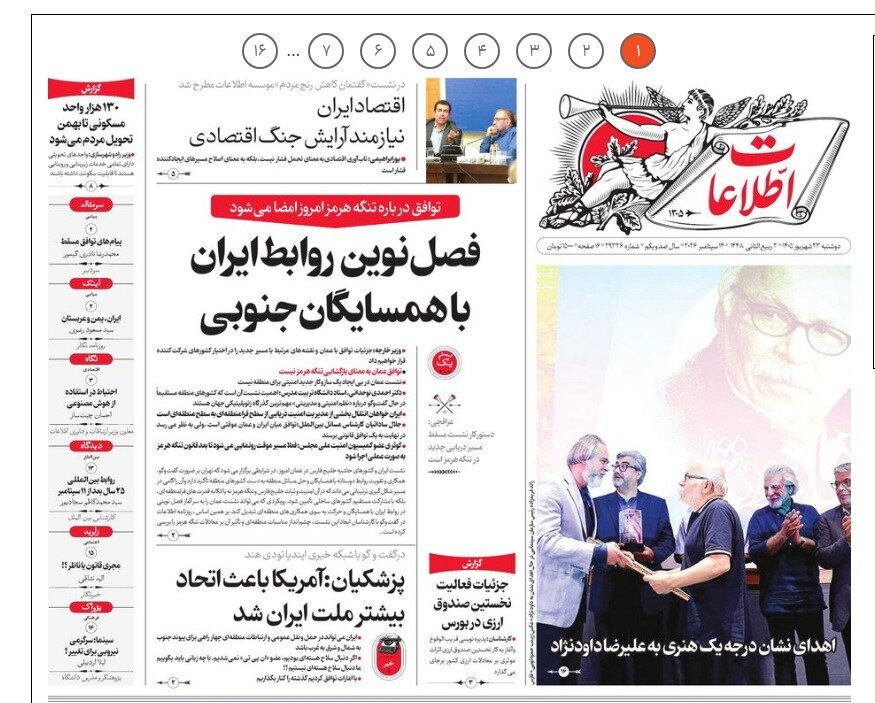
Ettelaat, in an analytical piece, examined the recent developments in Yemen. It wrote: What has been unfolding in Yemen in recent days goes far beyond a simple military shift between Ansarullah and Saudi‑backed forces.
Yemen is no longer merely an internal issue or even a regional conflict. Ansarullah’s consolidation at the mouth of the Bab al‑Mandeb strait — combined with developments surrounding the Strait of Hormuz — places two of the world’s most sensitive communication and energy chokepoints into a single strategic equation. Hormuz in the east and Bab al‑Mandeb in the west are two vital arteries of the global economy, and any serious disruption in either route could produce consequences far beyond the region itself. Therefore, what is emerging is a transformation in the geometry of regional deterrence. The two straits have now become interconnected in such a way that, if US attacks continue and the conflict expands, they could place the global economy’s lifelines under severe pressure. This is the earthquake that Yemen’s developments have triggered in regional calculations.
Hamshahri: Wrong signals are forbidden
Hamshahri, in its commentary, pointed to what it described as US desperation in the face of Iran. Some reports and rumors — claiming that Pakistani officials contacted Iran’s foreign minister requesting de‑escalation in Yemen and the Persian Gulf and a return to negotiations — caused oil prices to fall by four to five dollars. The response to hostility and blockade is reciprocal action, not negotiation or conciliation. This is the major lesson of the past year, especially the last few months. Now, the initiative on the battlefield lies with the resistance front. This leverage and authority must not be weakened by hesitation. Trump is desperate. Whenever he has imagined that the other side is hesitant, he has acted brutally. Now is the time for offensive action and sending a message of strength. Our political and diplomatic managers must not hesitate even for a moment in amplifying the message of battlefield deterrence.
Javan: Iran finds its path
Javan evaluated decades of US policy and Iran’s response. Washington had long hoped that cutting Iran off from Western financial networks would paralyze its foreign trade. But the reality is more complex. Iranian oil still finds its way to global markets, and foreign trade — though more costly and risk‑prone — has not stopped. In response to sanctions, Tehran has gradually shifted part of its trade flows away from dollar‑based channels toward parallel networks: alternative financial messaging systems, settlements in local currencies, barter arrangements, informal remittance systems, shadow fleets, and land‑based corridors. This development should be seen neither as a cost‑free victory for Iran nor as a complete failure of sanctions. What has occurred resembles structural adaptation: an economy that has lost direct access to Western financial infrastructure has built alternative systems or connected itself to existing networks in Russia, China, Central Asia, and the Middle East to sustain trade.
Vatan-e-Emrooz: From the pit of the Strait of Hormuz to the abyss of Bab al‑Mandeb
Vatan-e-Emrooz analyzed the crisis triggered by the halt of Saudi oil flows through the East–West pipeline after a drone attack. Saudi oil is largely produced and processed in the eastern part of the country. Its main export markets are in East Asia and other parts of the world. Under normal conditions, part of this oil travels through the Persian Gulf. If that route is disrupted, the East–West pipeline can carry oil to the Red Sea coast, from where it can reach global markets. But the Red Sea itself ends at Bab al‑Mandeb — a chokepoint at its southern entrance. Thus, if the Strait of Hormuz faces problems and Bab al‑Mandeb also becomes unsafe, transporting oil from eastern Saudi Arabia to the west does not necessarily mean it will reach buyers. Oil may arrive on land in Yanbu, but tankers must still traverse the Red Sea and reach their final markets. This is the missing link that multiplies the significance of recent events.
Leave a Comment